
Maria
Silk Master
Maria, who works and weaves silk
There is knowledge that doesn’t come from books or courses. They pass through the eyes through seeing the magic happen right in front of you. Like the rhythm of fingers on the loom, the patience of feeding the silkworms, the instinct to know when a thread is ready. Maria Corda has been watching these things since she was a child at home, in the courtyard, in her mother’s and grandmother’s hands. “We didn’t learn—we watched. They did it as their work,” she says.
In Orgosolo, silk-making has ancient roots, with written records dating back to the 1700s, though it likely existed even earlier. In Maria’s family, weaving has been passed down for over two hundred years. “We’re in the sixth or seventh generation. It’s a family tradition on my mother’s side.”
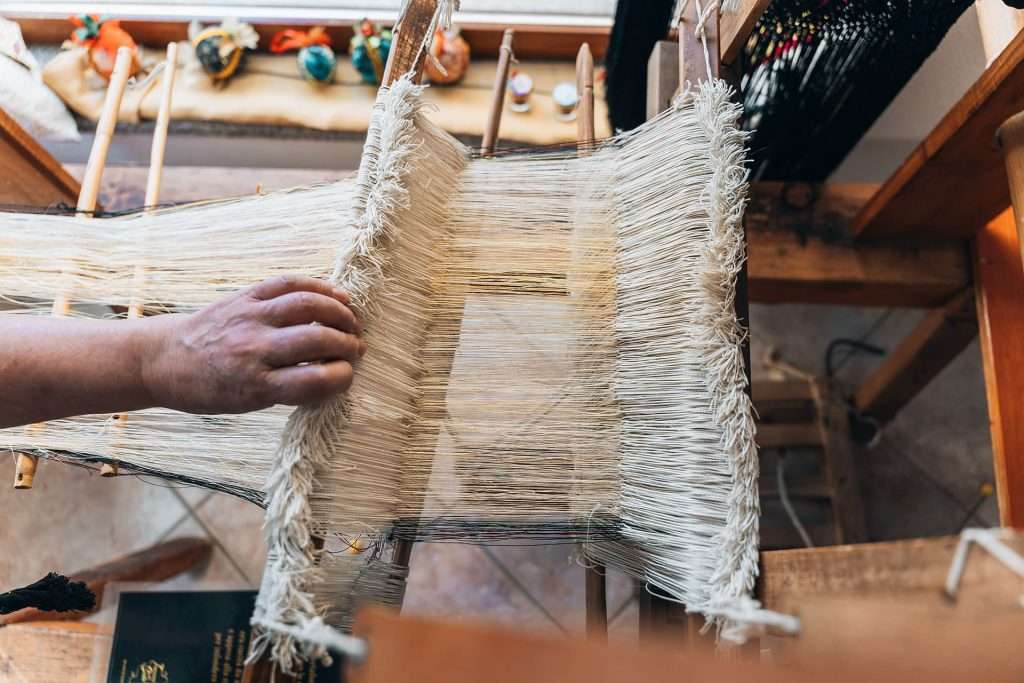
Once, almost every house in Orgosolo had a mulberry tree. Women raised silkworms to make Su Lionzu, the silk headpiece of the traditional women’s costume. It wasn’t bought—it was made. Silkworm raising was common knowledge, and the weaving was a collective task: eight women for the warping, entire courtyards taken over, and threads stretched for several meters. As Maria Corda recalls, “It was every woman’s duty to bring her own silk. There was a whole community behind each headpiece.”
Today, that knowledge is still alive. The tools are the same as they were back then: spindles, swifts, wooden pieces worn smooth from use. “Su Lionzu is made exactly as it was 250 years ago. Same tools, same time needed to make it.” Even the thread comes from the Orgosolo breed—deep yellow, less productive than other varieties but far more distinctive.
The work, then as now, is a women’s affair. “Even raising the silkworms was a woman’s task. The men who helped were teased, poems were written about them, people laughed,” she says.
Maria has never thought about stopping not even when continuing seemed impossible, when it felt like no one understood anymore. Because some things are done out of dignity. Or out of love. “I love my town too much, I love the traditional dress too much. It’s in my soul,” she says. Today, her greatest satisfaction is seeing her daughter want to carry on the craft.
The workshop she has run since 2005 has also become a place for storytelling. There are visits, school groups, tourists. “When I can show a caterpillar building its cocoon, the children say this is a magical place.”
What she loves about Orgosolo is the people, their grace, and its cultural richness. “I’m not saying it just because I’m from here—it’s true. I wouldn’t live anywhere else.”